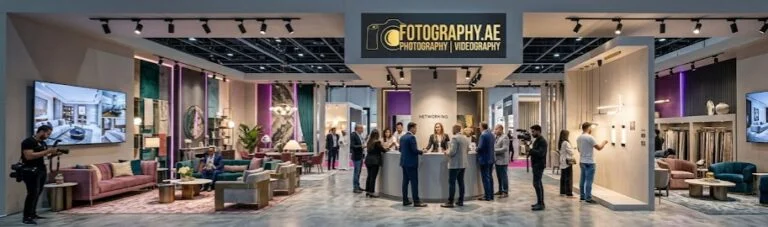
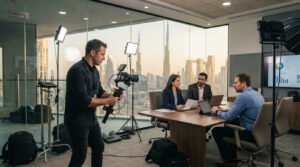
What Are Business Shoots? A Complete Definition
Business shoots are professional photography and videography sessions conducted for organizations covering everything from executive headshots to full brand documentaries.
They are not a single service. They are a category of visual production that serves multiple organizational functions simultaneously.
What Falls Under Business Shoots
| Type | What It Covers |
| Corporate Headshots | Executive portraits, employee profiles, LinkedIn visuals |
| Team Photography | Group shots, department photos, culture imagery |
| Office & Workspace | Interior environments, workstations, branded spaces |
| Corporate Events | Conferences, award ceremonies, panels, product launches |
| Branding & Lifestyle | Teamwork moments, culture scenes, employer brand content |
| Corporate Videography | Brand films, recruitment videos, leadership messages, testimonials |
Where These Assets Are Used
- Company websites and landing pages
- LinkedIn company pages and employee profiles
- Investor decks and pitch presentations
- PR packages and media kits
- Recruitment campaigns and employer branding
- Internal communications and onboarding materials
- Social media and paid advertising
What Business Shoots Are Not
Business shoots are not personal photography. They are not event party coverage. They are not social media content in the general sense. They are structured visual communication systems that feed an organization’s brand infrastructure for months or years after a single production day.
Key distinction: A personal photoshoot captures a moment. A business shoot builds a visual asset library.
Why Business Shoots Photography Is Brand Infrastructure, Not Content
This is the most important mindset shift for any company planning a visual production. Most organizations treat business shoots as a one-time task: take some photos, upload to the website, done. This approach fails within 12–18 months when teams grow, brands evolve, and visual assets become inconsistent.
The Brand Infrastructure Perspective
When business Shoots are treated as infrastructure:
- Every new hire receives a headshot that matches the existing team page because the visual standard is documented and repeatable
- Every marketing campaign pulls from a consistent image library because assets were planned with multiple use cases in mind
- Every investor or client sees a cohesive brand identity because all visuals follow the same lighting, framing, and editing system
When it is treated as content creation:
- Team pages look mismatched within a year
- Marketing pulls from five different shoot styles
- Leadership photos don’t align with company brand tone
- Every new hire triggers a new mini-shoot with no consistency
Why UAE and GCC Companies Face This Challenge More Acutely
In UAE and GCC markets, companies frequently operate across multiple nationalities, departments, and office locations, sometimes across Dubai, Abu Dhabi, Riyadh, and beyond. Staff turnover is higher than global averages in many sectors. Without a documented visual system, brand consistency collapses fast.
This is why fotography.ae, under Mashhood Arshad, delivers not just photos but repeatable systems that companies can execute across locations and over time.
The 5-Part System Behind Every Successful Corporate Shoot
Every successful business shoot regardless of size follows the same five-layer system. Most failed shoots are missing one or more of these layers.
Layer 1: Visual Standards (The Consistency Foundation)
This defines what all visuals must look like.
What a visual standard document includes:
- Background type: seamless white, environmental (office-based), or hybrid
- Lighting direction: frontal soft, split, Rembrandt
- Lighting character: hard vs soft, warm vs cool vs neutral
- Framing rules: headroom, angle, crop ratio (close-crop portrait vs mid-body)
- Color grading style: warm tone, neutral, cinematic
- Retouching level: light skin cleanup, full commercial retouching, or documentary minimal
- Export formats by platform: web (JPEG 72dpi), print (TIFF 300dpi), social (optimized square)
Without this layer: Two shoots three months apart look like they were taken by different companies.
Practical fix: Build a Visual Standard Sheet using 3–5 approved reference images plus written rules. This document is shared with every photographer or videographer hired including fotography.ae before production begins.
Layer 2: Logistics & Scheduling (The Flow Layer)
This controls time, movement, and coordination on production day.
What logistics planning covers:
- Time blocks per subject (headshots: 5–10 minutes each)
- People queue management system
- Room booking and access permissions
- Dedicated staging area for grooming and preparation
- Equipment transport and setup time
- Buffer slots for no-shows or late arrivals
Without this layer: Production days overrun by hours. People arrive randomly. Key subjects are missed. The shoot collapses into chaos.
Layer 3: Shot Planning (The Creative Map)
This defines every deliverable that must be captured.

A standard business shoot shot list includes:
- Leadership/executive portraits (formal and environmental)
- Mid-team individual headshots
- Department group shots
- Office environment wide angles
- Office environment detail shots (branded elements, spaces)
- Candid working moments
- Event coverage moments (if applicable)
- Branding lifestyle setups
Without this layer: You capture what’s convenient, not what’s needed. Teams discover missing assets during the website build requiring expensive reshoots.
Layer 4: Production Execution (On-Site)
This is actual photography or videography.
Key on-site responsibilities:
- Lighting setup and calibration before subjects arrive
- Real-time posing direction for non-models (most corporate subjects)
- Framing verification against the shot list
- On-site review of captured images for quality control
- Coordination with the client’s on-site coordinator
- Flagging any missing shots before wrap
Note: Production is the shortest layer in terms of planning effort, but the most visible. When Layers 1–3 are done correctly, Layer 4 runs smoothly regardless of complexity.
Layer 5: Post-Production & Delivery (The Output Layer)
This is where raw captures become usable business assets.
Post-production covers:
- Image selection and cull
- Retouching to the agreed visual standard
- Color grading for consistency across all images
- Export in all required formats and resolutions
- File naming conventions (critical for large teams)
- Delivery via agreed platform (WeTransfer, Google Drive, Dropbox, client portal)
Without defined standards here: Clients receive inconsistently edited files with no naming structure unusable for web developers or marketing teams.
Headshots For a Corporate Employee: How the System Works at Scale
Corporate headshots are the most frequently requested business Shoots in UAE and GCC and the most frequently mismanaged.
What a Headshot Is (and Isn’t)
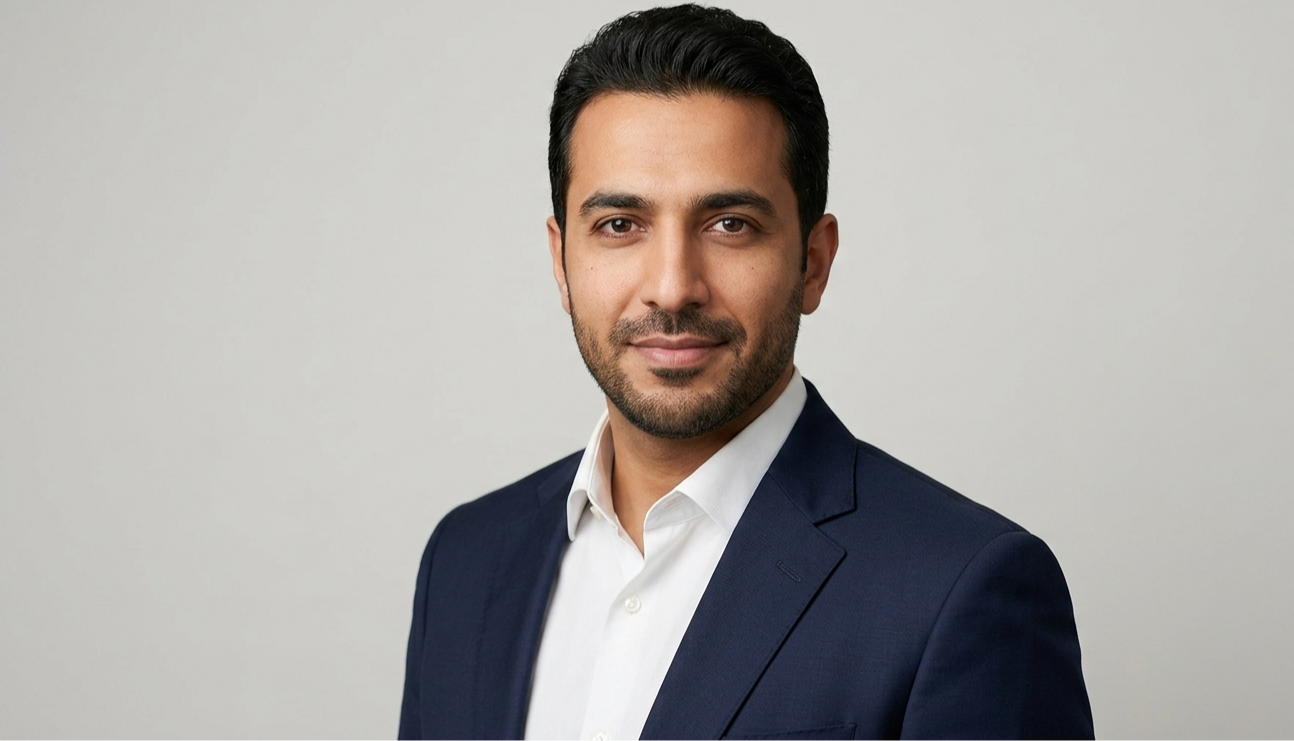
A corporate headshot is not a passport photo. It is a professional portrait that communicates personal brand, company culture, and visual identity simultaneously.
A successful headshot achieves:
- Technical consistency with all other team photos
- Natural expression that reads as confident and approachable
- Alignment with the company’s brand tone (formal corporate vs creative startup vs government)
The Scheduling System for Team Headshots
For teams of 10 or more, headshots require a scheduling system not open-door photography.
Recommended structure:
- 5–10 minute slots per person (varies by setup complexity)
- Advance notification to employees: minimum 3–5 days before shoot
- HR or office coordinator assigned as on-site manager
- Staging area separate from shooting area (for grooming and outfit adjustment)
- Buffer slots every 6–8 subjects for equipment checks
Why this matters: Without a queue system, employees arrive in clusters, creating bottlenecks. Some wait 45 minutes. Others are missed entirely. The shoot overruns.
Employee Preparation Guidelines
These instructions should be sent to every employee before the shoot day:
Wardrobe:
- Wear solid colours avoid busy patterns, stripes, or large logos
- Bring two options: one with jacket/blazer, one without
- Avoid shiny or reflective fabrics (satin, sequins)
- Dress consistent with how you appear in client-facing meetings
Grooming:
- Keep hair clean and natural avoid dramatic styling changes the day before
- Minimal accessories
- Men: shave or groom facial hair neatly
- Women: natural makeup preferred; avoid dramatic looks unless consistent with personal brand
On the day:
- Arrive 2 minutes before your slot
- Avoid large meals immediately before (affects comfort and posture)
- Relax most shoots take under 8 minutes per person
What Goes Wrong in Headshot Shoots (And Why)
| Problem | Root Cause | Prevention |
| Inconsistent background colour | No visual standard document | Create standard before shoot |
| Mismatched editing across team | Multiple editing hands, no style guide | Define retouching level in brief |
| Employees look uncomfortable | No posing direction from photographer | Hire experienced corporate photographer |
| People missed | No scheduling system | Use 5-minute slot booking |
| Reshoots required | No on-site review | Verify shots during production |
→ For team headshot bookings across Dubai, Abu Dhabi, and GCC, see Fotography.ae Corporate Headshot Services
Corporate Event Photography: Strategy Over Volume
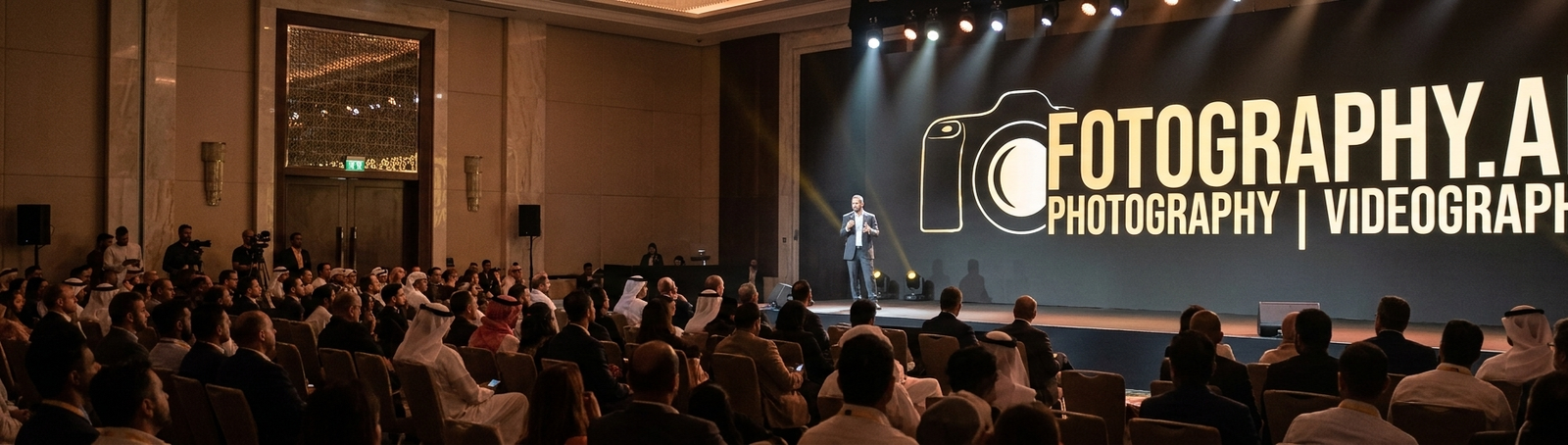
Event photography is not about capturing everything. It is about capturing the right things in a way that tells a coherent story about the event, the brand, and the people.
The Priority-Based Shot List for Events
Every event photographer from fotography.ae works from a pre-approved shot list. This list is built with the client before production day.
Standard corporate event shot categories:
- Pre-event setup venue branding, stage, signage, ambient environment
- Registration and arrival guest arrivals, networking, branded registration desk
- Keynote moments wide establishing shots, medium speaker shots, close facial expressions
- Panel discussions all panelists together, individual reaction shots, moderator
- Awards and recognition trophy handoff, recipient reactions, stage wide shots
- Audience engagement crowd wide shots, individual engaged expressions (non-intrusive)
- Networking breaks candid conversations, group interactions, catering areas if branded
- Sponsor visibility branded signage, sponsor booths, product placements
- VIP moments leadership interactions, key guest arrivals (from VIP list supplied by client)
- Post-event final group shots, recap moments
What Goes Wrong in Event Photography
The “cover everything” instruction is the single biggest mistake in corporate event photography.
When there is no priority list, photographers try to cover everything and end up capturing nothing of real value. Generic crowd shots. Empty hallways. Blurry candid moments. None of it usable for PR, press, or social media.
Essential planning inputs before any corporate event shoot:
- Run-of-show document (detailed schedule with timings)
- VIP list with names and photos (so the photographer recognizes key people)
- Sponsor requirements and logo visibility standards
- PR priorities (which moments must be captured for media releases)
- Any restricted areas or photography-forbidden zones
Event Coverage: Single Photographer vs. Multi-Camera
| Event Size | Recommended Coverage |
| < 50 attendees | 1 photographer |
| 50–200 attendees | 1 photographer + 1 videographer |
| 200–500 attendees | 2 photographers or 1 photographer + 2 videographers |
| 500+ attendees | Full multi-camera team |
→ For corporate event photography services in Dubai, Abu Dhabi, and GCC, see fotography.ae Event Coverage
Office & Workspace Photography: Clean Environment Standards
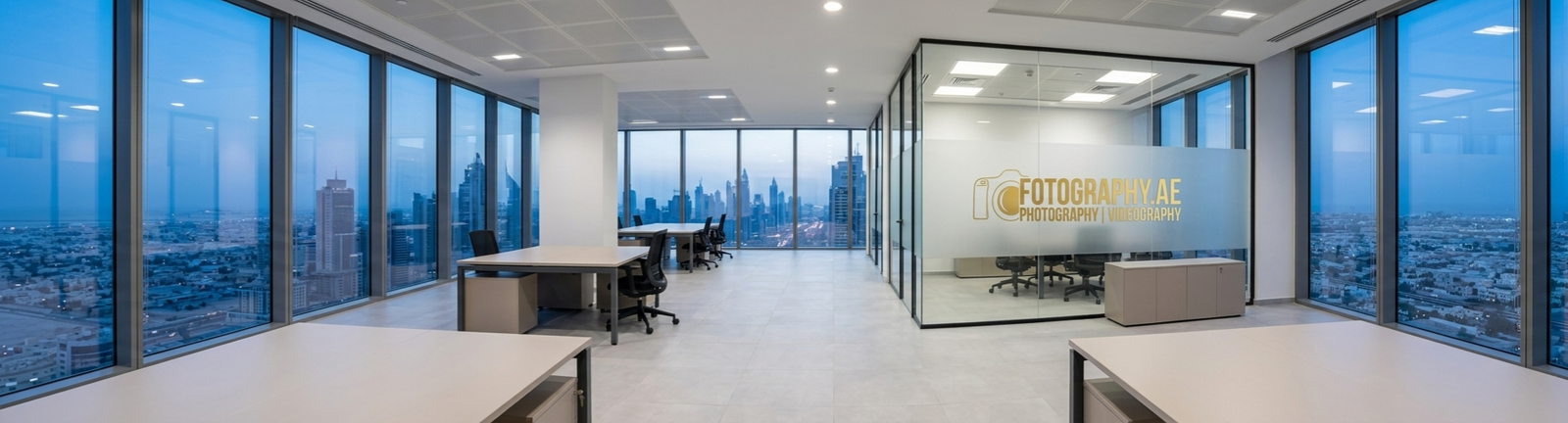
Office photography communicates company culture, scale, and brand credibility. A poorly shot office communicates the opposite of what the marketing team intends.
Why Office Photography Is Harder Than It Looks
Office environments are notoriously difficult to photograph well because:
- Mixed lighting sources (windows, overhead fluorescents, desk lamps) create colour casts
- Workspaces are rarely as clean as companies want them to appear
- Perspective distortion in small rooms makes spaces look cramped
- Branded elements are often placed incorrectly for camera angles
Professional office photography requires preparation, not just equipment.
The Pre-Shoot Office Preparation Checklist
Send this to the facilities or office management team at least 48 hours before the shoot:
Desk and workstation areas:
- Remove all personal items from visible desks (water bottles, phone chargers, personal photos)
- Clear visible cables tie and route out of frame or use cable covers
- Remove any confidential documents, papers, or sticky notes
- Align all monitors to consistent angles
- Empty waste bins
Meeting rooms:
- Align all chairs evenly around the table
- Remove coffee cups, pens, and personal items
- Clean glass surfaces and whiteboards
- Check that branded elements (logo walls, signage) are clean and unobstructed
Common areas:
- Remove any stacked boxes or storage visible in frame
- Ensure branded areas (reception, lobby) are fully stocked and pristine
- Turn on all lights to rated brightness (mixed on/off creates uneven lighting)
What to leave:
- Natural desk items that look intentional and clean (a laptop, a plant, a clean notepad)
- Any branded merchandise or company culture elements
- People (if lifestyle shots are included)
Lighting Considerations in UAE and GCC Office Environments
UAE offices frequently have floor-to-ceiling glazing, creating harsh window light during midday hours. The optimal shooting window is typically early morning (7:30–10:00 AM) or late afternoon (3:30–6:00 PM) for offices with eastern or western exposures.
For central offices with overhead fluorescent lighting only, gel correction is required to neutralize the green cast typical of older fluorescent systems.
→ For office environment photography in Dubai, Abu Dhabi, Riyadh, and across GCC, see fotography.ae Office & Workspace Photography
Branding & Lifestyle Content:

The Most Underused Business Asset
Branding lifestyle photography is the highest-value and most underused category in corporate visual production.
What Is Branding Lifestyle Photography?
It is photography that depicts real people doing real work in realistic settings but composed, lit, and directed to communicate brand values intentionally.
It is neither pure documentary (uncontrolled candid) nor pure commercial (obviously staged). It sits in the middle: authentic-feeling but intentionally crafted.
Why It Matters More Than Pure Headshots
Studies in visual communication consistently show that images of people in context perform significantly better than isolated portraits across websites, LinkedIn, and recruitment platforms. A team photo of three colleagues collaborating in a well-designed workspace communicates culture, energy, and brand values simultaneously. A headshot row communicates only that people exist.
Example Branding Lifestyle Shot Scenarios
| Scenario | What It Communicates |
| Two team members at whiteboard | Collaboration, problem-solving culture |
| Executive in conversation with team | Leadership accessibility, open culture |
| Small team in modern meeting room | Professionalism, contemporary workspace |
| Employee on laptop in branded area | Modern work environment, culture identity |
| Onboarding orientation scene | Growth, investment in people |
| Cross-departmental team discussion | Diversity, cross-functional collaboration |
Where Branding Lifestyle Content Is Used
- Recruitment campaign landing pages (the single highest-ROI use case)
- LinkedIn company page banners and posts
- Investor and pitch deck “Our Team” or “Our Culture” sections
- Employer branding pages
- Conference and event display materials
- Press kits and media coverage
How to Plan a Lifestyle Shoot
Unlike headshots (which are individual and sequential), lifestyle shoots require:
- Location scouting identify 3–5 key spaces within or near the office
- Cast selection select 4–8 employees who represent team diversity and are comfortable on camera
- Scenario scripting write 5–8 specific scenarios with roles and actions defined
- Prop and environment prep prepare each location with branded elements and clean styling
- Direction approach brief employees on what they will be doing (not posing, but doing)
→ For branding and lifestyle photography in UAE and GCC, see Fhotography.ae Lifestyle & Brand Photography
Photography vs. Videography: Which Does Your Business Actually Need?
This is one of the most common questions from corporate clients and the answer depends entirely on what the asset will be used for.
The Fundamental Difference
Photography creates a visual identity system. It builds a library of consistent, reusable assets that represent your brand across multiple channels, indefinitely.
Videography creates an emotional narrative. It communicates story, culture, and personality in a way that still images cannot but it has a much shorter shelf life and is significantly more expensive to produce.
Decision Framework
Choose photography when you need:
- A consistent team and leadership identity (headshots)
- Website hero images and section visuals
- PR and press kit assets
- LinkedIn and social media profile images
- Investor presentation visuals
- Assets that will be reused across 12–24+ months
Choose videography when you need:
- A brand story that requires emotional engagement
- A leadership message or CEO communication
- A recruitment campaign that needs to feel human and compelling
- A product or service explainer
- An event highlight reel for post-event marketing
- Social media video content for LinkedIn or YouTube
Choose both when you need:
- A comprehensive brand refresh
- A new company launch
- A major recruitment campaign with multiple channels
- An investor roadshow package
Cost and Time Comparison
| Factor | Photography | Videography |
| Production time | Half day to full day | 1–3 days (with pre-production) |
| Post-production time | 3–7 days | 2–6 weeks |
| Asset lifespan | 2–4 years | 6–18 months |
| Versatility | Very high (many channels) | Medium (specific formats) |
| Emotional impact | Moderate | High |
| Cost (UAE market) | AED 2,000–20,000+ | AED 6,000–80,000+ |
Corporate Videography: The Full Production Workflow
Corporate video is a multi-phase production. Unlike photography where the bulk of work is in planning and on-site execution, video involves equal weight across three distinct phases.
Phase 1: Pre-Production
Pre-production determines 80% of a video’s quality before the camera turns on.
Pre-production deliverables:
- Creative brief objectives, audience, tone, key messages
- Script or outline for interview-based videos, this is a question guide; for scripted videos, a full teleprompter script
- Shot list every scene, angle, and B-roll requirement
- Storyboard for complex productions with specific visual sequences
- Location scouting report confirmed locations with lighting assessment
- Talent/cast briefing for employees who will appear on camera
- Equipment plan camera, audio, lighting requirements confirmed
- Schedule production day timeline with confirmed participants
Common pre-production failures:
- Interviewees arrive without knowing what they will be asked
- Locations are not pre-lit assessment (discovered on day to be unusable)
- No clear message hierarchy (video tries to say too many things)
- Script not approved before shoot day (causes expensive re-shoots)
Phase 2: Production
Key technical elements of corporate video production:
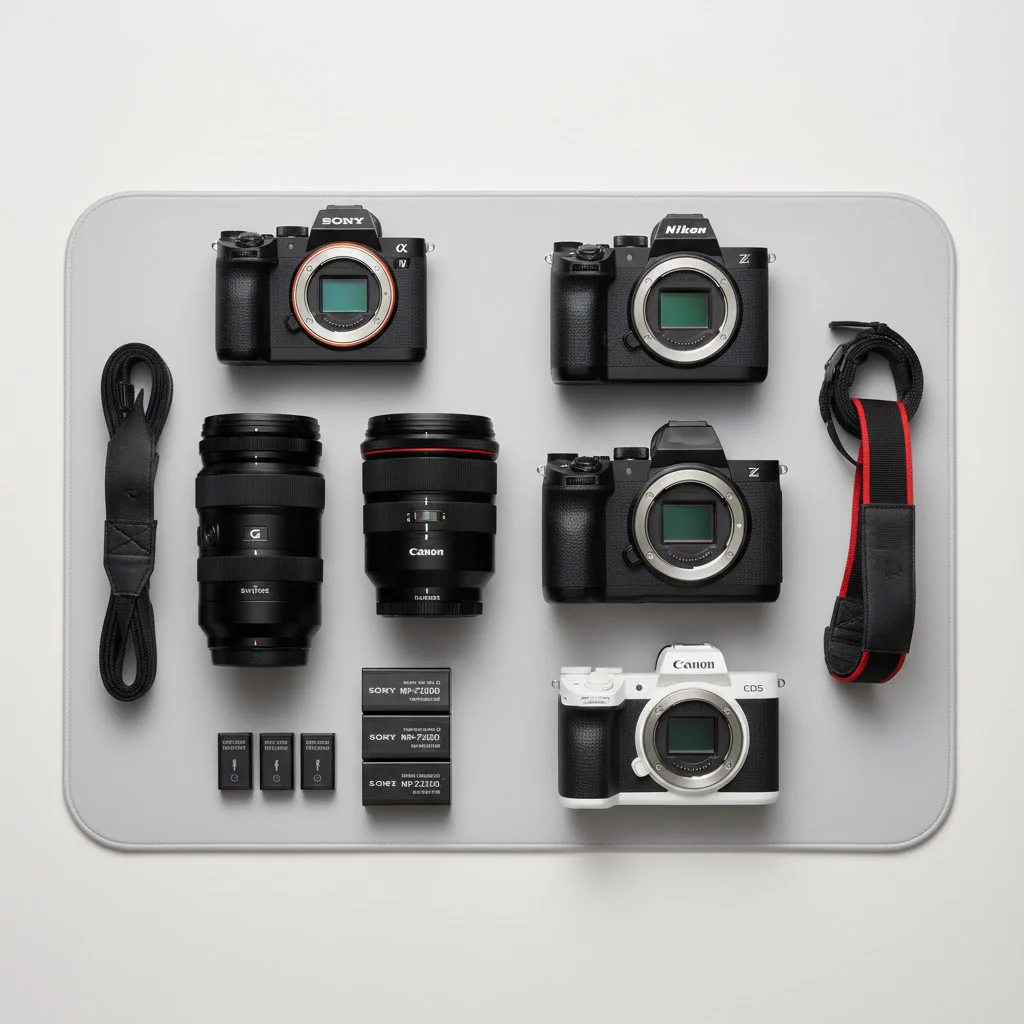
Camera: 4K minimum for future-proofing; LOG profile shooting for grading latitude
Audio: Lavalier microphone for interviews (not camera mic); room tone recording for post
Lighting: Three-point lighting minimum for interview setups; motivational lighting for office environments
B-roll: Plan 3× more B-roll than you think you need editors always run short
Takes: Minimum 3 takes of every scripted line; 5+ takes for critical CEO messages
Direction for non-actors: Most corporate subjects are not professional talent. Direction is the primary skill that separates professional corporate videographers from general content creators.
Phase 3: Post-Production
Post-production workflow:
- Footage ingest and organization
- Rough cut assembly (narrative structure)
- Client review round 1 (structure approval)
- Fine cut (timing, transitions, pacing)
- Graphics and lower thirds (name titles, company details)
- Music selection and audio mix
- Color grading
- Final export in required formats (16:9 for web, 9:16 for social, 1:1 for certain platforms)
- Delivery
Typical post-production timelines:
- 60–90 second brand video: 2–3 weeks
- 2–5 minute brand documentary: 3–5 weeks
- Full event highlight reel: 1–2 weeks
- Interview series (5 episodes): 4–6 weeks
→ For corporate videography services in UAE and GCC, see fotography.ae Corporate Videography
Freelancer vs. Agency in UAE & GCC: How to Choose
This is a budget and complexity decision not a quality decision. Both freelancers and agencies can deliver excellent work.

The question is which model fits your project’s requirements.
When a Freelancer Is the Right Choice
Best suited for:
- Teams of 5–50 people
- Single-office shoots
- Projects with clear, simple briefs
- Fast turnaround requirements (under 2 weeks)
- Budget-conscious projects without complex production needs
Advantages of hiring a freelancer:
- Direct communication with the photographer or videographer no account manager layer
- Faster decision-making and flexibility
- Lower overhead costs translate to better pricing
- Easier to reschedule or adjust scope
Limitations:
- Single operator cannot simultaneously manage complex multi-room shoots
- Limited additional crew for large-scale productions
- No in-house second shooter, stylist, or art director
- Some editing turnarounds may be slower during peak periods
When an Agency Is the Right Choice
Best suited for:
- Large organizations (100+ employees)
- Multi-location shoots across UAE and GCC
- Complex campaigns requiring multiple crew roles
- Productions needing full creative direction, styling, and art direction
- Companies needing a single vendor for photography, video, and post-production
Advantages of hiring an agency:
- Structured production team (photographer, videographer, assistant, art director)
- Project manager handling logistics independently
- Consistent brand management across multiple shoots
- More capacity to absorb complexity
Limitations:
- Higher cost (agency overhead is built into pricing)
- More communication layers (account manager → producer → photographer)
- Slower to respond to last-minute changes
The Fotography.ae Model
fotography.ae, led by Mashhood Arshad, operates as a specialist freelance practitioner delivering agency-level planning and output with the direct communication and flexibility of a senior freelancer. This model is particularly well-suited to UAE and GCC mid-market companies who need professional-grade results without full agency overhead.
Decision Matrix
| Requirement | Freelancer | Agency |
| Team of < 50 | ✓ Best fit | Overkill |
| Multi-location GCC shoot | Possible | ✓ Better fit |
| Fast turnaround (< 1 week) | ✓ Best fit | Slower |
| Complex production crew | Limited | ✓ Best fit |
| Direct communication | ✓ Best fit | Account manager layer |
| Budget < AED 10,000 | ✓ Best fit | Hard to scope |
| Corporate brand campaign | ✓ Specialist fits | ✓ Also fits |
UAE & GCC Pricing Guide: What Business Shoots Really Cost
Important note: The figures below represent current 2025 market ranges in UAE and GCC. Pricing varies based on deliverable count, editing complexity, location logistics, and shoot duration. These ranges are for planning purposes. For a specific quote aligned to your project scope, contact fotography.ae directly.
Photography Pricing (UAE Market 2025)
| Service | Freelancer Range (AED) | Agency Range (AED) |
| Individual Executive Headshot | 350–900 | 900–2,500 |
| Team Headshots (up to 20 people) | 1,800–5,000 | 4,500–14,000 |
| Team Headshots (20–50 people) | 4,000–9,000 | 10,000–25,000 |
| Office Environment Photography | 2,500–7,000 | 7,000–20,000 |
| Corporate Event (half day) | 2,500–6,000 | 7,000–18,000 |
| Corporate Event (full day) | 4,500–10,000 | 12,000–28,000 |
| Branding & Lifestyle (half day) | 2,500–7,500 | 7,000–22,000 |
| Branding & Lifestyle (full day) | 4,500–12,000 | 12,000–35,000 |
Videography Pricing (UAE Market 2025)
| Service | Freelancer Range (AED) | Agency Range (AED) |
| Corporate Interview / Talking Head | 3,000–7,000 | 8,000–18,000 |
| Half-Day Video Production | 3,500–9,000 | 9,000–28,000 |
| Full-Day Video Production | 6,000–16,000 | 18,000–45,000 |
| Full Brand Video (60–90 sec) | 8,000–22,000 | 22,000–60,000 |
| Brand Documentary (3–5 min) | 14,000–35,000 | 35,000–90,000 |
| Event Highlight Reel | 5,000–14,000 | 14,000–35,000 |
GCC Market Pricing Notes
Pricing in Saudi Arabia (Riyadh, Jeddah), Qatar (Doha), Bahrain, and Kuwait varies from UAE pricing by ±15–25% depending on local market conditions, travel logistics, and permit requirements. Shoots outside UAE typically include travel and accommodation costs for UAE-based photographers.
What Drives Cost Up
- Short notice booking (< 5 days)
- Large team sizes without a pre-organized schedule
- Multiple locations in a single day
- Extensive retouching requirements
- Multiple rounds of editing revisions
- Rush delivery (< 48 hours)
What Reduces Cost
- Clear brief delivered before shoot
- Organized scheduling system already in place
- Defined final image count agreed before shoot
- Single revision round with consolidated feedback
- Standard (non-rush) delivery timeline
Technical Standards Every Corporate Shoot Must Define
Before any business shoot begins, the following technical standards must be confirmed in writing. Leaving these undefined creates disputes at delivery.
Visual and Creative Standards
Tone of visuals:
- Corporate formal (dark backgrounds, high contrast, sharp details)
- Professional neutral (clean light, soft shadows, brand-neutral)
- Warm and approachable (soft light, warmer tones, more candid feel)
- Creative / startup (environmental, moody, more editorial)
Color grading:
- Warm tone (golden, slightly lifted shadows)
- Neutral / clean (as-captured, minimal grade)
- Cool and crisp (desaturated highlights, blue shadow tones)
- Match to existing brand assets (provide reference images)
Technical Delivery Standards
| Attribute | Options to Specify |
| Resolution | Full resolution (print), web-optimized (72dpi JPEG), social-ready |
| File format | JPEG, TIFF, PNG, RAW (client retains rights) |
| Aspect ratio | 1:1, 4:3, 16:9, 3:2 (varies by platform) |
| Color space | sRGB (web/screen), Adobe RGB (print) |
| Minimum image count | Define upfront not “photographer’s discretion” |
Subject Standards
Wardrobe guidelines: (Specify per industry and brand)
- Financial services: formal business attire, dark/navy colours
- Technology/startup: smart casual, brand-aligned
- Creative agencies: brand-expressive, relaxed professional
- Government/public sector: formal, subdued colours
Retouching level:
- Light (skin cleanup, temporary blemish removal only)
- Standard (skin smoothing, flyaway hair, minor corrections)
- Commercial (full skin retouching, wardrobe corrections, background cleanup)
- Documentary (no retouching news/PR standard)
Naming and File Organization
For teams of 20+, file naming is critical for HR and web development teams. Define the convention before delivery:
Budget Optimization: How Clarity Saves Money
The most effective cost-reduction strategy for business shoots is not negotiation, it is clarity.
The Clarity Cost Model
Every vague element in a brief creates cost:
- Vague shot list → additional shoot time or reshoot
- Undefined image count → open-ended editing commitment
- No visual standard → multiple revision rounds
- No decision-maker identified → feedback loops that delay delivery
- Last-minute changes → overtime and rush fees
Specific Steps to Optimize Budget
Before the shoot:
- Define the exact final deliverable count (e.g., “30 final retouched headshots, 20 office environment images”)
- Agree on revision rounds in writing typically 1–2 rounds is standard
- Standardize the editing style using 3–5 reference images
- Confirm all locations and subjects before booking date
- Assign a single internal decision-maker who approves all creative choices
During the shoot:
- Have an on-site coordinator managing the people queue
- Review images on-camera or tethered display before wrapping each setup
- Confirm the shot list is complete before the photographer leaves
After the shoot:
- Consolidate all feedback from all stakeholders before submitting to photographer
- Avoid piece-meal feedback over multiple emails
- Do not request edits that fall outside the agreed visual standard
Hidden Costs to Watch For
- Travel and parking: In Dubai especially, confirm whether travel time between locations is billed
- Permit fees: Dubai Media City, DIFC, and certain government areas require photography permits
- Model releases: If lifestyle images feature non-employee models, model release costs apply
- Music licensing: For videos, all background music must be licensed this is a separate cost
- Rush fees: Most photographers charge 25–50% surcharge for delivery under 48 hours
Common Mistakes That Kill Corporate Shoot Quality
These are the most frequent failures seen across UAE and GCC business shoot productions, based on 6+ years of experience with corporate clients.
Mistake 1:
No Single Internal Decision-Maker
Multiple stakeholders each submitting separate feedback is the fastest way to turn a well-executed shoot into an endless revision cycle. Assign one person with authority to give final approvals before production begins.
Mistake 2:
Unclear Deliverables
“Good photos of our team” is not a brief. A brief specifies: image count, formats, resolutions, intended platform, subject list, and any restricted shots. Without this, deliverables become a guessing game.
Mistake 3:
No Shot List
Even a one-page shot list prevents the most common post-shoot disaster: discovering that a key asset was not captured. Shot lists take 30 minutes to prepare and save days of reshoot logistics.
Mistake 4:
Inconsistent Editing Expectations
“Make it look like our website” is meaningless without reference images. Provide 3–5 approved references that represent the target editing style. Misaligned expectations here lead to unlimited revision requests.
Mistake 5:
Poor Scheduling on Shoot Day
Allowing employees to “come anytime” for headshots creates a production collapse. Use 5–10 minute slots with a designated coordinator managing the queue.
Mistake 6:
No Visual Standard Document
Without a documented visual standard, every shoot even by the same photographer drifts over time. This creates mismatched visual identity across team pages, website sections, and marketing materials.
Mistake 7:
Booking Too Late
In UAE and GCC markets, experienced corporate photographers book 2–4 weeks in advance for standard shoots and 4–8 weeks for large productions. Last-minute bookings compromise quality and increase cost.
Mistake 8:
Confusing Photography with Videography for the Same Use Case
Some clients commission a short video when they need a photo library, and vice versa. Clarify the intended platform, message, and audience before deciding on medium.
The Complete Corporate Shoot Checklist
Use this checklist for every business shoot, photography or videography.
4 Weeks Before (Strategic Planning)
- Define objectives: what must this shoot achieve?
- Confirm budget range
- Assign single internal decision-maker
- Identify all subjects (names, departments, availability)
- Draft shot list
- Book photographer/videographer
- Reserve locations (offices, meeting rooms, studios)
- Obtain any required photography permits
1–2 Weeks Before (Pre-Production)
- Visual standard document approved with reference images
- Shot list finalized and approved
- Shoot schedule distributed to all participants
- Employee preparation guidelines sent (wardrobe, grooming, timing)
- Office preparation checklist sent to facilities team
- Equipment and lighting plan confirmed with photographer
- Video script or interview questions approved (if applicable)
48 Hours Before (Final Checks)
- Confirm all participants are available
- Check all room bookings and access permissions
- Final review of shot list for any additions
- Confirm delivery timeline and format requirements
- Identify any restricted areas or confidential concerns
- Brief on-site coordinator on their role
Day of Shoot (On-Site)
- Photographer arrives 45–60 minutes before first subject for setup
- Run test shots and confirm technical settings before subjects arrive
- Coordinator manages queue from first slot
- Shot list is visible on-site for real-time tracking
- On-camera review at end of each setup before moving to next
- Final shot list review before photographer wraps confirm all captured
Post-Production Phase
- Photographer confirms image count and delivery timeline
- Single consolidated feedback from one decision-maker per round
- Final approval in writing before delivery is marked complete
- Files archived in agreed naming convention
- Visual standard document updated if any variations were approved
Frequently Asked Questions
This section is structured to answer every search and conversational query related to business shoots in UAE and GCC. Each answer is written for AI-readability and featured-snippet optimization.
General Business Shoots
What is a business shoot?
A business shoot is a professional photography or videography session conducted for a company. It includes corporate headshots, office environment photography, event coverage, branding and lifestyle imagery, and corporate video production. Business shoots produce visual assets used on websites, LinkedIn, investor decks, and marketing materials.
What is corporate photography used for?
Corporate photography is used for company websites, LinkedIn company and employee profiles, press kits and media releases, investor and pitch presentations, recruitment campaigns, employer branding, internal communications, and social media content.
How is business photography different from personal photography?
Business photography is a structured, repeatable visual production system designed to serve multiple organizational functions over time. Personal photography captures individual moments for personal use. Business photography requires documentation, consistency standards, shot planning, and integration with brand guidelines.
What is included in a corporate photoshoot?
A standard corporate photoshoot includes: executive and employee headshots, team group photography, office and workspace environment imagery, branding and lifestyle scenes, and event coverage if applicable. Deliverables include retouched digital files in specified formats.
Headshots and Team Photography
How long does a corporate headshot take?
A single corporate headshot session takes 5–10 minutes per person when the lighting is pre-set and a scheduling system is in place. Without scheduling, the process is significantly slower and less consistent.
What should employees wear for corporate headshots?
Employees should wear solid colours that align with the company’s brand tone, avoid busy patterns and large logos, and bring two options, one with a jacket or blazer and one without. Shiny or reflective fabrics should be avoided. Grooming should be natural and clean.
How do you ensure consistency across team headshots?
Consistency is achieved through a documented visual standard that specifies background type, lighting setup, framing rules, color grading style, and retouching level. The same standard is applied to every subject regardless of when in the shoot they appear.
How many headshots can be done in a day?
With a scheduled queue system and controlled studio lighting, a corporate photographer can typically complete 30–60 individual headshots in a full day, depending on setup complexity and coordination efficiency.
Can corporate headshots be done in the office?
Yes. Office-based headshots use environmental backgrounds (often a blurred or lit section of the actual office) instead of seamless backdrops. Both styles are valid; the choice depends on brand tone and visual standard preference.
Events
What should a corporate event photographer capture?
A corporate event photographer should capture keynote speakers, panel discussions, award presentations, audience engagement, networking moments, sponsor branding, VIP arrivals, and branded environment shots. The specific priorities should be defined in a shot list before the event.
How far in advance should I book a corporate event photographer?
In UAE and GCC markets, corporate event photographers should be booked 2–6 weeks in advance for medium-to-large events. For major conferences or multi-day productions, 6–12 weeks is recommended.
Do I need a videographer and photographer for a corporate event?
For events of 50+ people where content will be used across multiple channels (PR, social media, recap video), having both a photographer and videographer is recommended. For smaller internal events, a photographer alone is typically sufficient.
Office Photography
How do I prepare my office for a photography shoot?
Remove personal items from desks, clear cables, align furniture, clean glass surfaces, remove confidential documents, turn on all lights, and ensure branded areas are clean and well-stocked. A detailed preparation checklist should be sent to your facilities team 48 hours before the shoot.
What time of day is best for office photography?
Early morning (7:30–10:00 AM) and late afternoon (3:30–6:00 PM) are typically best for offices with large windows, to avoid harsh midday sun creating overexposed windows and dark interiors. For fully internal offices with only artificial lighting, time of day matters less.
How long does an office photoshoot take?
A standard office environment shoot covering 5–8 key areas takes 3–6 hours. Larger offices or those requiring extensive styling and preparation may require a full day.
Videography
What is corporate videography?
Corporate videography is professional video production for business purposes. It includes brand films, recruitment videos, CEO and leadership messages, product and service explainers, event highlight reels, testimonial videos, and internal communication videos.
How long does a corporate video take to produce?
Pre-production takes 1–2 weeks. Filming typically takes 1–3 production days. Post-production for a 60–90 second video takes 2–3 weeks. A full brand documentary (3–5 minutes) takes 4–8 weeks from brief to delivery.
What is the difference between corporate photography and videography?
Photography creates a visual identity system, a library of reusable images with long shelf life. Videography creates an emotional narrative, a story-driven format that drives engagement but has a shorter reuse lifespan. Both serve different organizational communication goals and the choice depends on intended use.
How much does a corporate video cost in Dubai?
A basic corporate interview video in Dubai costs AED 3,000–7,000 with a freelancer. A full brand video (60–90 seconds, scripted and graded) costs AED 8,000–22,000 with a specialist freelancer and AED 22,000–60,000 with a full production agency.
Pricing and Planning
How much do corporate headshots cost in Dubai?
Individual corporate headshots in Dubai cost AED 350–900 with an experienced freelance photographer and AED 900–2,500 with a production agency. Team headshots for 20 people typically range from AED 1,800–5,000 with a freelancer.
How much does corporate photography cost in the UAE?
Corporate photography in UAE ranges from AED 2,500 for a basic half-day shoot to AED 35,000+ for comprehensive full-day brand shoots with large teams. Cost depends on team size, shoot duration, deliverable count, and editing complexity.
Is a freelance photographer or agency better for corporate shoots in UAE?
Freelancers are better for small-to-medium teams needing fast turnaround with direct communication and lower cost. Agencies are better for large-scale productions, multi-location shoots, and complex campaigns requiring multiple crew roles. A senior specialist freelancer like fotography.ae delivers agency-level quality with freelancer flexibility.
How do I reduce the cost of a corporate photoshoot?
Define your deliverables clearly before booking, limit revision rounds to one or two, provide a prepared shot list, use a scheduling system for headshots, and avoid last-minute bookings. Clarity is the primary cost-control mechanism.
UAE and GCC Specific
Do I need a permit for photography in Dubai?
Photography in public spaces in Dubai, within free zones like DIFC and Dubai Media City, and in certain government buildings may require a filming permit. Your photographer should advise on permit requirements for each specific location.
Can corporate shoots be done across multiple GCC locations?
Yes. fotography.ae covers UAE and GCC markets including Saudi Arabia, Qatar, Bahrain, and Kuwait. Multi-location shoots require additional pre-production coordination, travel logistics, and scheduling. Fees include travel and accommodation for shoots outside UAE.
What industries in UAE most commonly commission corporate shoots?
The most frequent corporate photography clients in UAE span financial services, technology and SaaS, real estate and property development, hospitality and retail, government and semi-government entities, professional services (consulting, legal, accounting), and healthcare.
Working With a Photographer
What should I send to a corporate photographer before the shoot?
Send a detailed project brief including: shoot objectives, subject list, shot list, visual reference images, schedule, location details, access information, delivery format requirements, and any brand guidelines. The more information provided upfront, the smoother production runs.
How many images will I receive from a corporate photoshoot?
This should be agreed in the brief before production. A standard half-day headshot shoot produces 1–3 final retouched images per person. A full-day office and branding shoot might deliver 40–100 final retouched images. Agree on counts in writing to avoid scope disputes.
How long does it take to receive images after a corporate photoshoot?
Standard delivery is 5–10 business days after the shoot. Rush delivery (48 hours) is available at additional cost. Large team shoots with 50+ people may require 10–15 business days for full editing.
What is a visual standard document?
A visual standard document is a written brief that defines how all images from a shoot must look, specifying background type, lighting style, framing rules, color grading, and retouching level. It is shared with the photographer before production and becomes the reference for all editing decisions.
About Fotography.ae & Mashhood Arshad
Fotography.ae is a UAE-based corporate photography and videography practice founded by Mashhood Arshad, a specialist in business and commercial visual production with over 6 years of experience working with corporate clients across UAE and GCC.
Experience:
- 6+ years of corporate photography and videography across UAE and GCC markets
- Client base spanning financial services, technology, real estate, government, hospitality, and professional services
- Specialization in team headshot systems, branding lifestyle content, corporate events, and office environment photography
Operating regions:
- Dubai, Abu Dhabi, Sharjah (UAE)
- Riyadh, Jeddah (Saudi Arabia)
- Doha (Qatar)
- Manama (Bahrain)
- Kuwait City (Kuwait)
Approach: fotography.ae operates at the intersection of structured production systems and professional visual craft. Every engagement begins with a visual standard, a defined shot list, and a logistics framework ensuring that deliverables are consistent, on-brand, and usable across all intended channels.
→ For service inquiries, please visit Fotography.ae
Final Takeaway
Business shoots in UAE and GCC succeed when treated as structured production systems not one-time creative sessions.
The companies that build lasting visual identity do so through:
- Documented visual standards that make every shoot consistent
- Clear planning systems that eliminate production-day surprises
- Defined deliverables that control cost and scope
- Structured logistics that respect people’s time
- Post-production standards that make assets immediately usable
A successful shoot is never created on the day. It is engineered before production begins.
Guide maintained and updated by Fotography.ae. For the latest information on services, pricing, and availability, contact us directly at Fotography.ae.
All pricing ranges reflect UAE market data as of 2025. GCC pricing varies by market and project scope.